Notes Close
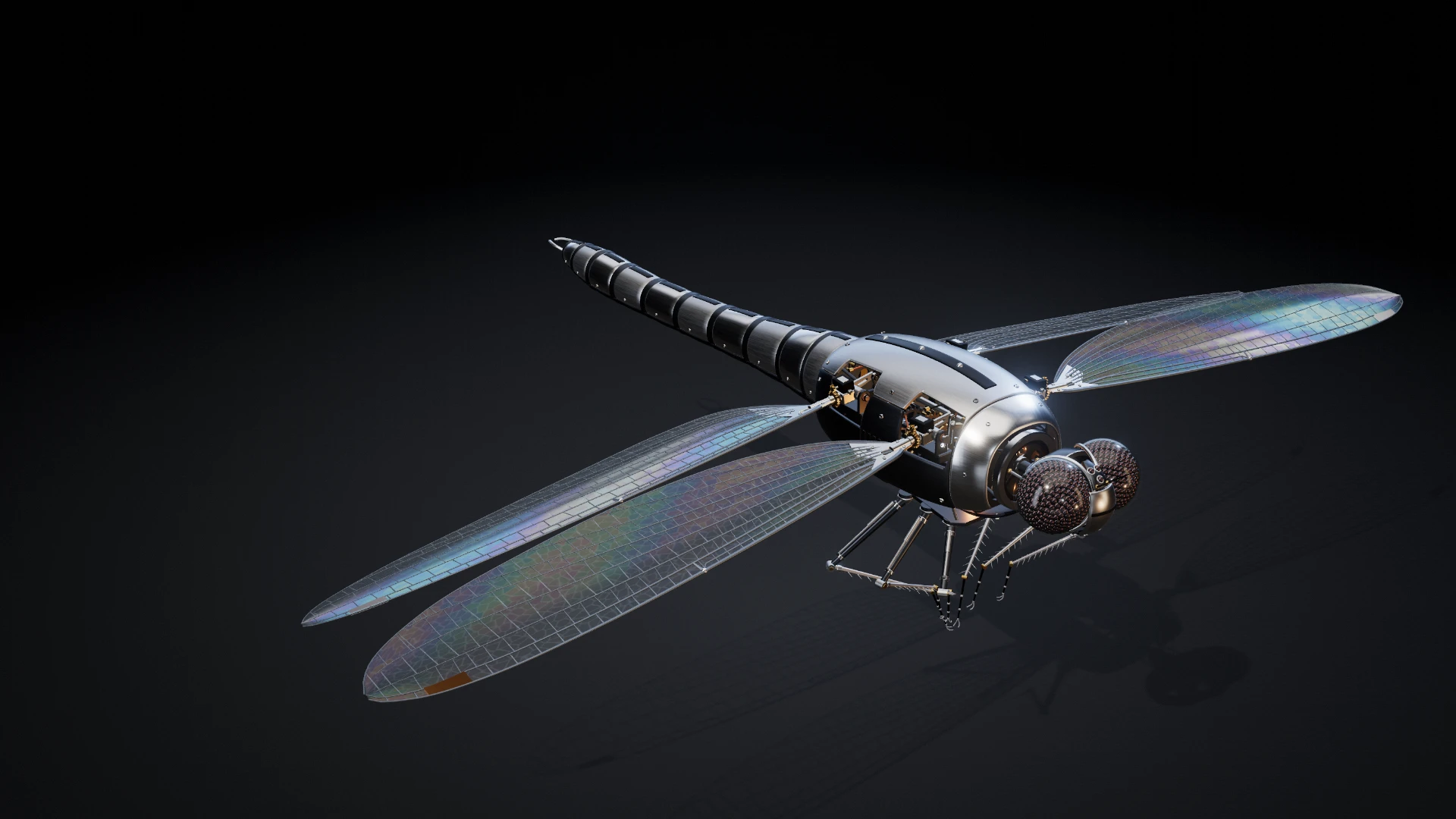
ANAX is an original design study, not a product and not a model of any existing machine. Every part is generated in the browser from dimensions held in one file; nothing is scanned, downloaded or photographed.
What is exact
The wing drive is a real crank-and-rocker linkage and is solved every frame: the connecting rods keep their length and stay on their pins at any crank angle. Gear pairs share a module, sit at their true centre distance and turn at their tooth ratio, including the planetary stage. The figures on each part's card are read from the model.
What is illustration
Nothing here has been built or flown. Loads, materials, electronics and the tail's shape-memory coils are drawn to be plausible, not engineered. The wings beat far slower than a dragonfly's so the mechanism can be followed by eye.
Starting points
Festo, BionicOpter (2013). A flying dragonfly that showed one main motor and small per-wing servos can be enough. ANAX borrows that division of labour, not its design.
Mechanical watch movements, for the habit of leaving the going train open to view.
Dragonfly anatomy: nodus, pterostigma, the ten abdominal segments, and the forward basket of legs.
Controls
Drag to turn, scroll or pinch to zoom, right-drag or two fingers to slide. Select any part, here or in the Index, to bring it forward. Space opens and closes the machine, the arrow keys step it, R returns the view, Escape lets go of a part.
Typeface: Roboto Flex and IBM Plex Mono, SIL Open Font License. Rendering: three.js, MIT License. Notices